
A boat trailer is a frame on an axle, with a coupler at the front to hitch it and bunks or rollers on top to carry the hull. A winch at the front pulls the boat on. Underneath, leaf springs and the hubs with their bearings do the hard work. Definitions follow Discover Boating's trailer guides and Dexter, the axle maker.
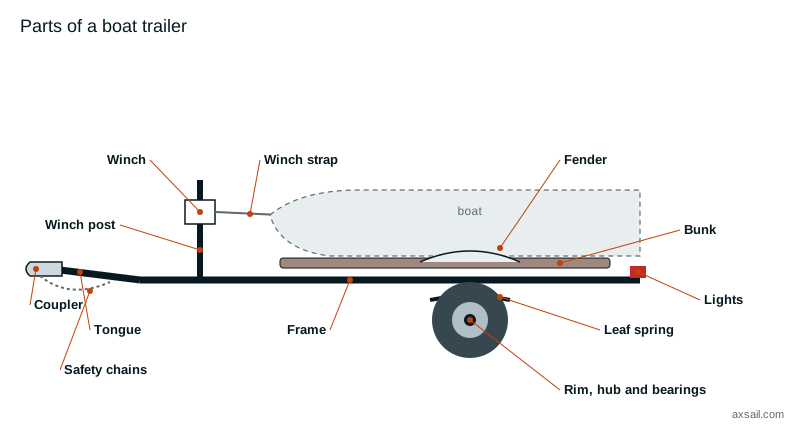
The parts
| Part | What it does |
|---|---|
| Coupler | Locks onto the tow ball; on trailers with surge brakes the actuator sits here and needs occasional lubrication |
| Bunks | Long carpeted boards that support the hull on a bunk trailer |
| Rollers | Rubber or plastic rollers on pivoting bases that carry the hull on a roller trailer |
| Winch | Cranks the boat onto the trailer |
| Axle, spindles and rims | Tyres mount on rims, rims bolt to spindles, spindles attach to the axle |
| Bearings | Inside the hub, reducing friction as the wheel turns |
| Grease fitting or sight glass | For packing grease-lubricated bearings, or checking oil-lubricated ones |
| Leaf springs | The suspension, held by hangers, shackles and U-bolts that Dexter lists for regular checks |
| Lights | Rear lights, side markers and the wiring that runs them front to back |
What wears out
Tyres age before they wear, bearings last as long as their grease and seals, and springs crack or lose their arch. The details are on how long boat trailer tyres last and when to replace trailer leaf springs. The boat trailer inspection checklist has the wiring colours and a check for each part.
For surveyors
When a boat sells with its trailer, a walk round the trailer often goes in the report. With Axsail, say "port hub hot after a short tow, grease thrown inside the wheel" as you photograph it and it's written as a trailer finding.