
An outboard motor is built in sections. The powerhead on top is the engine, and the midsection carries its drive down to the lower unit under the water. Below the lower unit is the skeg; behind it the propeller. A bracket holds the whole motor on the boat's transom and lets it steer and tilt. Definitions come from Universal Technical Institute and Sea Tow.
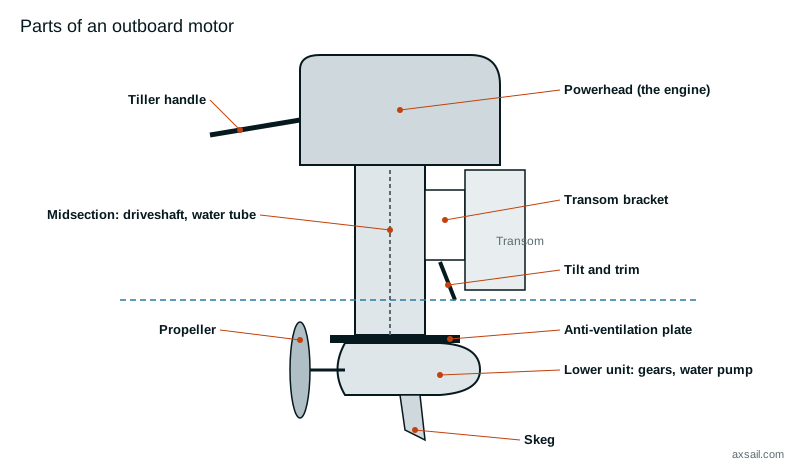
The parts
| Part | What it does |
|---|---|
| Powerhead | The engine: cylinders, crankshaft, valves, spark plugs or injectors |
| Midsection | Connects the powerhead to the lower unit, carrying the driveshaft, cooling water tube and exhaust passage |
| Driveshaft | Turns inside the midsection and takes the engine's torque down to the gears |
| Lower unit | Under the water: the gear set turns the drive 90 degrees to the propeller shaft |
| Water pump impeller | In the lower unit, lifting raw water up to cool the engine |
| Anti-ventilation plate | A small fin above the propeller that sheds air bubbles and reduces cavitation |
| Propeller | Turns the shaft's torque into thrust |
| Skeg | The lowest point of the motor; steers and protects the propeller |
| Bracket | Attaches the motor to the transom and lets it turn to steer |
| Tilt and trim | Lifts the motor out of the water and sets its angle; manual on small motors, powered on larger ones |
| Tiller handle | Steers a small outboard directly by hand |
Sea Tow adds that the shaft length is matched to the transom height, with 15, 20 and 25 inch markings on the motor.
What surveyors look at
Corrosion on the midsection and bracket, the gear oil from the lower unit, and the tell-tale stream from the cooling system. The outboard corrosion and impeller findings show how they're graded, and how long outboard motors last covers hours. With Axsail, name the part as you photograph it and the finding goes into the engine section.