
A sailboat mast is held up by its standing rigging: shrouds at the sides, a forestay and backstay fore and aft. Spreaders hold the shrouds out from the mast, and each wire ends in a turnbuckle and a chainplate. The diagram shows the mast from ahead, the view where the shrouds and spreaders are easiest to see.
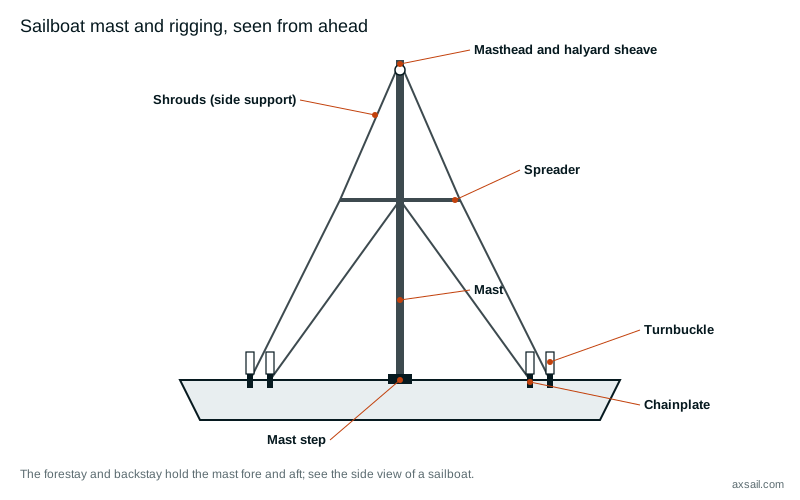
The parts
| Part | What it does |
|---|---|
| Mast | The vertical pole that carries the sails |
| Masthead | The top of the mast, with the sheaves the halyards run over |
| Spreaders | Short horizontal struts on the mast that push the shrouds outward |
| Shrouds | Fixed wires holding the mast from side to side |
| Forestay and backstay | Fixed wires holding the mast fore and aft |
| Turnbuckle | Between the bottom of each shroud and its chainplate; adjusts the shroud's length to tension it |
| Clevis and cotter pins | The clevis pin joins the turnbuckle to the chainplate; the cotter pin stops it backing out |
| Chainplate | The fitting a shroud or stay attaches to, carrying the rig's load into the hull |
| Mast step | What the bottom of the mast stands on, on deck or on the keel |
| Roller furler | On many boats, the drum and foil on the forestay that roll the headsail away |
What wears
The swage terminal and old standing rigging pages cover the checks, and the replacement every 10 years that Yachting Monthly says insurers generally recommend.
For surveyors
On a rig survey, work from the deck fittings up: chainplates, turnbuckles, pins, then the mast step and spreaders. With Axsail, say "starboard upper shroud turnbuckle, cotter pin missing" as you photograph it and the finding is written with its grade.