
A sailboat has the same hull, bow and stern as any boat, plus a rig: the mast, the boom, the sails and the wires and lines that hold and control them. The diagram labels the parts on a sloop, a boat with one mast and one headsail. Definitions come from Discover Boating and the American Sailing Association.
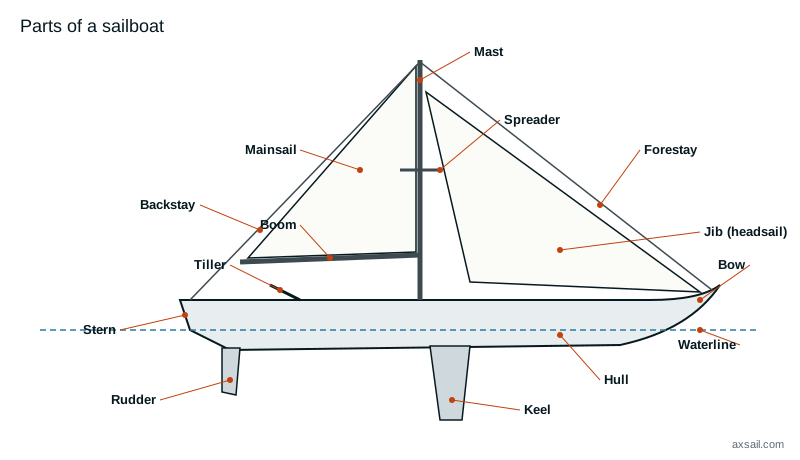
The rig
| Part | What it does |
|---|---|
| Mast | The tall vertical pole that carries the sails |
| Boom | The horizontal pole from the foot of the mast that holds the bottom edge of the mainsail |
| Mainsail | The large sail on the mast and boom, the main source of drive |
| Jib or headsail | Any sail in front of the mast; a genoa is a larger one |
| Forestay and backstay | Wires holding the mast fore and aft |
| Shrouds | Wires holding the mast from side to side |
| Spreaders | Short struts on the mast that push the shrouds outward |
| Halyard | The line that hoists or lowers a sail |
| Sheet | The line that sets a sail's angle to the wind |
| Winch | A drum that lines wrap round, to multiply pulling force |
Shrouds and stays together are the standing rigging; the mast and rigging page labels them in detail.
Below the waterline and at the helm
| Part | What it does |
|---|---|
| Keel or centreboard | The fin under the hull that keeps the boat upright; a centreboard pivots up into a slot in the hull |
| Rudder | The movable fin at the stern that steers |
| Tiller or wheel | Turns the rudder; small boats use a tiller, larger ones a wheel |
| Cockpit | The recessed part of the deck where the helmsman sits |
Rig types
Discover Boating lists four common rigs: a sloop has one mast and one headsail, a cutter one mast and two headsails. A ketch and a yawl both have two masts; on a ketch the smaller mizzen mast stands forward of the rudder post, on a yawl behind it.
For surveyors
A rig survey works through these parts from the masthead down. See how long sails last and old standing rigging for how they're judged. With Axsail, name the part as you photograph it and it lands in the rig section of the report.