
A dual battery boat setup keeps one battery for starting the engine and a second for the house loads, so a flat house bank can't stop you starting. The usual way to charge both is an automatic charging relay (ACR), also sold as a voltage sensitive relay (VSR). It joins the banks while charging and separates them when charging stops.
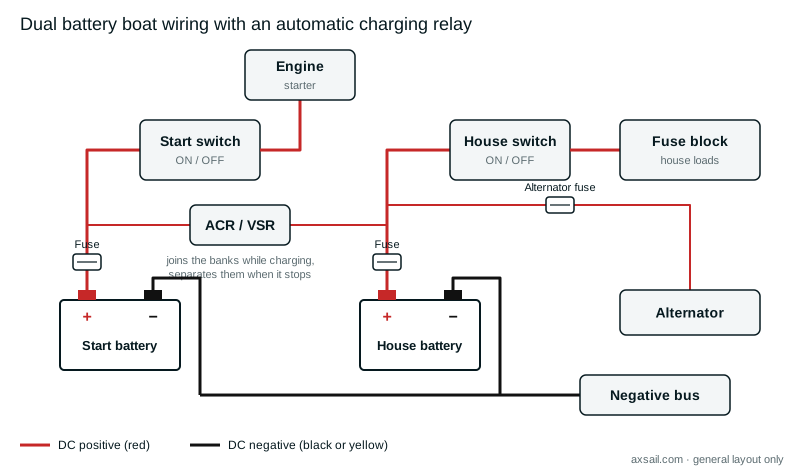
How the ACR works
Practical Boat Owner's Ben Meakins describes a Blue Sea ACR that combines the banks after a two-minute delay when it detects charge on either battery, and isolates them when charging stops. On his boat both banks read 14.3 V with the engine running. With the engine off, the house bank showed 12.39 V and the start bank 12.65 V, so the relay was keeping them apart. Start isolation opens the relay while the engine cranks, so house loads don't pull the start battery down.
The 1/2/BOTH switch problem
Many older boats charge two batteries through a 1/2/BOTH switch. Rod Collins of Compass Marine lists its failures. Owners leave it on BOTH and run both banks dead, switch more than they need to, or forget to charge one bank. Turning it through OFF while the engine is charging can cause a voltage spike that damages the alternator's diodes. His preferred upgrades add an ACR and fuses, and he says those fuses are required under ABYC standards.
48° North lists the diode isolator as the other old option and says it drops about 0.5 V, leaving the batteries undercharged.
Where the fuses go
| Connection | What the sources say |
|---|---|
| Each bank's positive | Fused within 7 in (175 mm) of the battery under E-11 |
| ACR and alternator | Connected on the load side of each bank's fuse, per Compass Marine |
| Alternator to house bank | Fused at 150% of alternator output, within 7 in of the house positive, per Compass Marine |
| ACR feeds | PBO's install used a pair of 60 A fuses with 16 mm² cable for a 35 A alternator |
| Start bank fuse | At least 250 A, preferably 300 A, for small diesels, per Compass Marine |
For surveyors
Find out how the banks are charged: an ACR, a diode isolator or a switch the owner turns. Check each bank has a fuse at the battery and that both banks share a chemistry if an ACR joins them. Ask whether the switch normally lives on BOTH. The battery switch finding covers the grades. With Axsail, say "two banks charged through 1/2/BOTH, no ACR, owner leaves it on BOTH" as you photograph the switch, and it's written up.