
Axsail
STANDARDS · ABYC

Boat wiring color code: the ABYC E-11 colours for DC positive, negative, grounding and engine circuits, with a chart

UPDATED 15 NOVEMBER 2026 · 2 FINDINGS · 2 SOURCES

The ABYC boat wiring color code as a chart: red positive, black or yellow negative, green grounding, and the engine and accessory colours from E-11 Table XV.

AT A GLANCE
ABYC E-11 wiring colour code
OFFICIAL TITLE
ABYC E-11, AC and DC Electrical Systems on Boats: Table XIV wiring color code and Table XV engine and accessory wiring color code
COVERS
DC conductors on boats: red positive, black or yellow negative, green or green with yellow stripe for grounding, plus one colour set for engine and accessory circuits
SURVEYORS CHECK
That each conductor's function can be identified, that yellow isn't used for both negative and the blower, and that any other scheme comes with a wiring diagram
GET THE TEXT
From ABYC; an earlier edition is published free by law.resource.org

The ABYC colour code for boat wiring is in E-11, the standard for AC and DC electrical systems on boats. Red is DC positive, black or yellow is DC negative, and green or green with a yellow stripe is the DC grounding (bonding) conductor. A second table gives colours for engine and accessory circuits. The figures below are from the edition of E-11 published free by law.resource.org; ABYC sells the latest revision.
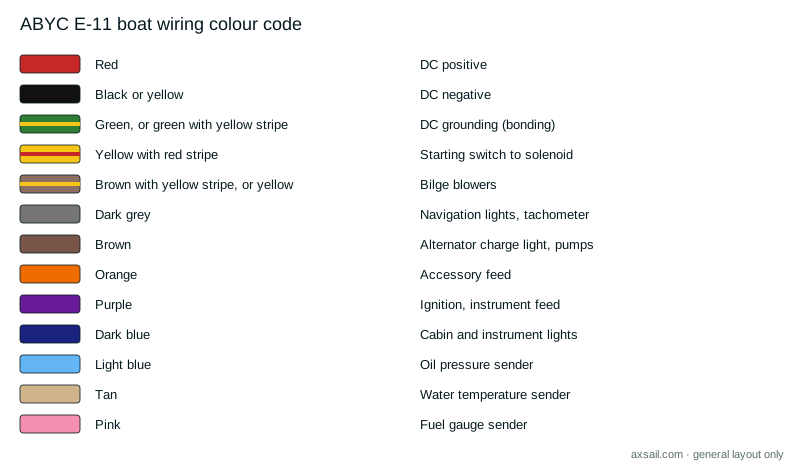
ABYC E-11 boat wiring colour code chart, from red DC positive to pink fuel gauge sender
The E-11 colours as a chart. Print it for the boat or the van.

General DC wiring (Table XIV)

Colour Use
Green, or green with yellow stripe(s) DC grounding conductors
Black, or yellow DC negative conductors
Red DC positive conductors

Engine and accessory wiring (Table XV)

Colour Item Runs from and to
Yellow with red stripe Starting circuit Starting switch to solenoid
Brown with yellow stripe, or yellow Bilge blowers Fuse or switch to blowers
Dark grey Navigation lights, tachometer Fuse or switch to lights; sender to gauge
Brown Generator armature, alternator charge light, pumps Armature to regulator; fuse or switch to pumps
Orange Accessory feed Ammeter to alternator output and accessory fuses or switches; panel to accessory switch
Purple Ignition, instrument feed Ignition switch to coil and instruments; panel to electric instruments
Dark blue Cabin and instrument lights Fuse or switch to lights
Light blue Oil pressure Sender to gauge
Tan Water temperature Sender to gauge
Pink Fuel gauge Sender to gauge
Green with a stripe (not green/yellow) Tilt down, trim in Tilt and trim circuits
Blue with a stripe Tilt up, trim out Tilt and trim circuits

E-11 notes that where yellow is used for DC negative, the blower wire must be brown with a yellow stripe, so the two can't be confused.

What E-11 allows instead

E-11 asks that every conductor in the boat's electrical system has a means of identifying its function, with an exception for pigtails under 7 inches (175 mm). The engine and accessory colours are described as one selection. Other identification is allowed when the boat comes with a wiring diagram showing the method. Colour can be added with coloured sleeving or at the terminations, and marking tape must be at least 3/16 inch (5 mm) wide.

For surveyors

Colour tells you when wiring has been added by an owner rather than the builder: red used for negative, household cable, or one colour for every circuit. Those are findings in their own right; see household wiring on a boat. The single battery and fuse box diagrams show where each colour runs. With Axsail, say "added circuit to the fishfinder run in red for both conductors" as you photograph it, and it's written up against E-11.

Findings judged against ABYC E-11 wiring colour code

Each page shows how the defect is found, what decides the grade and example findings written up at A, B and C.

ELECTRICAL

Household wiring

Why household cable and wire nuts don't belong on a boat, what marine wire is, what a surveyor looks for behind panels and in lockers, what rewiring involves and three example findings graded A, B and C.

How to find and write it up
ELECTRICAL

Battery switch

What goes wrong with a boat's 1-2-Both battery switch, why turning it through Off with the engine running can kill the alternator, the flicker test for a worn switch, what a surveyor checks and three example findings graded A, B and C.

How to find and write it up

Frequently asked

What is the color code for boat wiring?

Under ABYC E-11, red is DC positive, black or yellow is DC negative, and green or green with a yellow stripe is the DC grounding conductor. E-11 also gives a colour set for engine and accessory circuits, such as purple for ignition and orange for accessory feeds.

Why is boat negative wire yellow?

ABYC E-11 allows black or yellow for DC negative. E-11 also uses black for the ungrounded conductor in AC wiring, so on a boat with shore power a yellow DC negative is easier to tell apart. If yellow is used for negative, E-11 says the bilge blower must be brown with a yellow stripe.

What color is the bilge pump wire on a boat?

E-11's engine and accessory table lists brown for pumps, from the fuse or switch to the pump. Bilge blowers are brown with a yellow stripe, or yellow where black is used for negative.

Does a boat have to follow the ABYC colour code?

E-11 asks that every conductor's function can be identified. Its engine and accessory colours are one option: other means of identification are allowed if the boat comes with a wiring diagram showing the method.

Your full survey report, minutes after the walk-round

Dictate as you inspect. Axsail builds the findings and the report for your signature

Start free

Related standards

All standards
ABYC E-11

AC and DC Electrical Systems on Boats

What ABYC E-11 covers on a boat's AC and DC systems, the rules surveyors check most often, from the 7 inch battery fuse rule to the reverse polarity indicator, and how to cite E-11 in a finding.

What surveyors check
SINGLE BATTERY WIRING DIAGRAM

Single battery DC layout, judged against ABYC E-11 and 33 CFR 183 subpart I

A single battery boat wiring diagram: the main fuse within 7 inches, the battery switch, the fuse block and a bilge pump that runs with the switch off.

What surveyors check
FUSE BOX WIRING DIAGRAM

DC distribution through a fuse box, judged against ABYC E-11 and 33 CFR 183.455

A boat wiring diagram with a fuse box: main fuse, feeder to the fuse box, one fuse per circuit sized to its wire, and the negative bus bar, with the ABYC rules.

What surveyors check
DUAL BATTERY WIRING DIAGRAM

Two-bank DC layout, judged against ABYC E-11

Dual battery boat setup with a wiring diagram: start and house banks, an ACR or VSR to charge both, the 1/2/BOTH switch problem and where the fuses go.

What surveyors check
ABYC

American Boat and Yacht Council standards

What the American Boat and Yacht Council is, how its standards are written and kept up to date, why they're voluntary but still decide survey findings, how to get the full text, and the standards surveyors cite most.

What surveyors check
ABYC E-13

Lithium Ion Batteries

What ABYC E-13 asks of lithium battery systems on boats, the 600 Wh threshold, the BMS requirement, documentation and restraint, what a surveyor checks and how to cite E-13 in a finding.

What surveyors check