
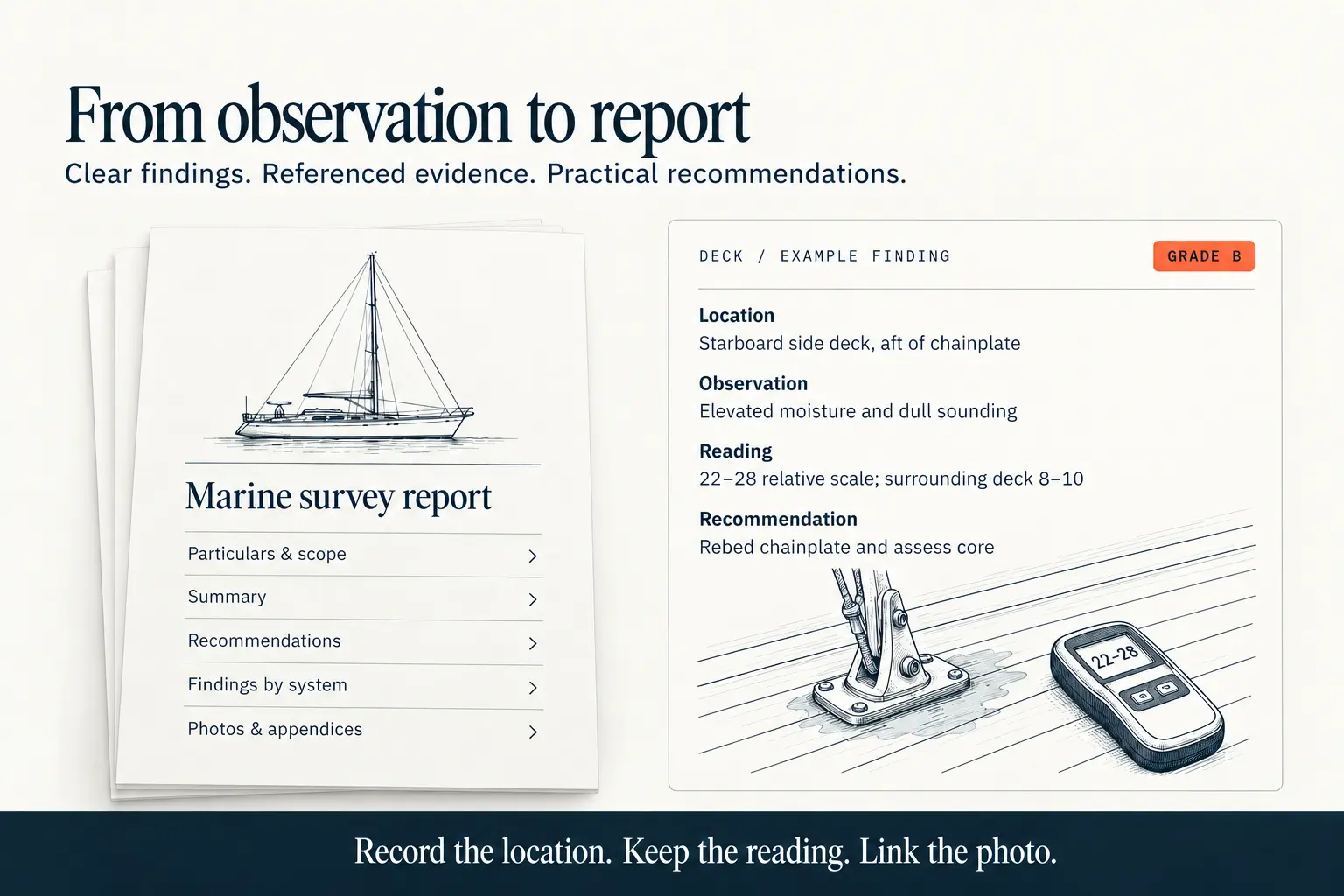
A marine survey report is the written record of a survey: who asked for it, what was inspected, what was found, what the surveyor recommends and how urgent each item is. Buyers use it to decide and to negotiate, insurers to set cover, lenders to secure a loan, and yards as a work list.
Most reports share the same skeleton, whatever the surveyor's template looks like. This guide lays it out section by section, shows how a single finding should be written, and explains the usual grading of recommendations.
Who reads the report, and what they look for
| Reader | Reads first | Wants to know |
|---|---|---|
| Buyer | Summary and recommendations | What it will cost to put right, and whether anything is a reason to walk away |
| Insurer | Recommendations graded as urgent, valuation | Whether the boat is an acceptable risk and what must be fixed before cover starts |
| Lender | Valuation, ownership details | Whether the boat is worth the loan |
| Broker | Summary | Whether the deal will hold at the agreed price |
| Yard or engineer | Findings by system | Where each defect is and what to do about it |
Each reader opens the report at a different page. That is why the summary has to work alone, and why every finding has to make sense without the paragraph before it.
The sections of a marine survey report
The order varies between surveyors. The content barely does.
| # | Section | What it contains |
|---|---|---|
| 1 | Cover and particulars | Vessel name, make and model, year, hull identification number, registration, length, beam, draft, engines, hull material. Client name, date and place of survey, type of survey, report number. |
| 2 | Scope | Who asked for the survey and why, whether the boat was inspected ashore, afloat or both, whether there was a sea trial, and the standards or codes of practice followed. |
| 3 | Limitations | What could not be inspected and why: fixed linings, full lockers, tanks not opened, mast not unstepped, no access aloft. |
| 4 | Summary | Overall condition in a few paragraphs, written for someone who reads nothing else. |
| 5 | Recommendations | Every recommendation in one list, graded by urgency, each with a reference to the finding behind it. |
| 6 | Findings by system | Hull and underwater, deck, rig and sails, engine and fuel, electrical, gas, plumbing and tanks, interior and structure, safety equipment, sea trial. |
| 7 | Readings and measurements | Moisture readings with the meter used and its scale, engine hours, battery voltages, ultrasonic thickness on metal hulls. |
| 8 | Valuation | Market value and how it was reached, in condition and valuation surveys. |
| 9 | Surveyor's declaration | Name, qualifications, membership numbers, signature and date. |
| 10 | Photos and appendices | Photos referenced from the findings, the grading scheme, copies of inspected documents. |
The legal text, meaning copyright, confidentiality, liability and governing law, sits at the front or the back. It belongs to the surveyor's terms of business and rarely changes between reports.
Scope and limitations deserve more care than they get
A buyer finds wet core under a cockpit locker six months after the purchase. The first thing anyone checks is whether the report said the locker was full and could not be inspected. A precise limitations section protects the surveyor and tells the client exactly where the remaining risk sits. List the areas that were not seen. A general line that "not all areas were accessible" protects no one.
How to write a finding
A finding is the unit of the report. Each one should carry six things:
- System: Hull, Electrical, Gas, and so on.
- Location: precise enough for a yard to walk to it. Port or starboard, forward or aft, and a reference point.
- Observation: what the surveyor saw, heard or measured.
- Reading: the measured value and the instrument, where there is one.
- Recommendation: what should be done.
- Grade: how urgent it is.
Two versions of the same finding:
| Weak | Usable |
|---|---|
| Some moisture in the deck. Recommend further investigation. | Deck. Starboard side deck, 30 cm aft of the shroud chainplate, area about 40 × 25 cm. Elevated readings, 22 to 28 on the meter's relative scale, against 8 to 10 on the surrounding deck. Deck sounds dull in the same area. Likely water in the core around the chainplate. Recommend rebedding the chainplate and assessing the core, by a GRP specialist. Grade B. |
The usable version tells the buyer what to price, the yard where to cut, and the insurer that the surveyor measured it. The weak version only tells all three that someone should look again.
Photos
- One photo per finding at least, referenced by finding number.
- A wide shot to place the defect on the boat, then a close-up of the defect itself.
- Something for scale in close-ups: a ruler, a coin, a known fitting.
- Captions that repeat the location, since photos are often forwarded on their own.
Grading recommendations
Almost every surveyor grades recommendations, and the schemes differ. Some use three grades, some five. A common three-level scheme:
| Grade | Meaning | Typical examples |
|---|---|---|
| A | Fix before the boat is used. Affects safety or seaworthiness. | Gas hose past its date, seacock seized open, cracked chainplate, no working bilge pump |
| B | Fix soon, within the season or before the next long passage. | Wet core around a deck fitting, stern gland weeping, worn cutless bearing |
| C | Routine maintenance or an improvement. | Faded gelcoat, minor chafe on running rigging, labels missing on the switch panel |
Whatever scheme you use, define it in the report and apply it the same way every time. Insurers read grade A items as conditions of cover. A grade A that should have been a B costs the owner time and money. A safety item graded C can come back to the surveyor.
How the report changes with the type of survey
| Survey | Report length and depth | Distinctive sections |
|---|---|---|
| Pre-purchase | Longest. Every system in depth. | Sea trial results, detailed recommendations the buyer can price |
| Condition and valuation (insurance) | Shorter. Structure, safety, main risks. | Valuation, insurer-style grading |
| Damage | Covers the incident only. | Cause of damage, repair specification, sometimes a cost estimate |
| Charter check-in and check-out | Short and repeatable. | Same items every time, photos dated to compare against the last check |
The yacht survey checklist lists what gets inspected in each system. This guide covers how it ends up on paper.
A template to follow
If you are building or reviewing your own template, check it against this list:
- Particulars filled from documents, not from memory, with the hull identification number checked against the boat.
- Scope states ashore, afloat or both, and whether there was a sea trial.
- Limitations list specific areas.
- Summary fits on one page.
- Recommendations list cross-references every finding, with its grade.
- Every finding has system, location, observation, reading where relevant, recommendation and grade.
- Readings name the instrument and the scale.
- Every photo is referenced from a finding and captioned with the location.
- Grading scheme defined in the report.
- Declaration signed and dated.
Most surveyors keep this in a word-processor template and fill it in after the survey from notes, voice memos and photos. Specialist survey software adds structured fields and photo handling. Either way, the content of each finding is only as good as what was captured on board.
Where reports lose detail
The inspection takes a day. The report is written later, at the desk, from whatever came back: a notebook with wet pages, a few hundred photos named by timestamp, and memory. That is where readings go missing, "aft of the chainplate" becomes "near the chainplate", and two findings in the same locker merge into one.
We built Axsail to capture the finding while the surveyor is still looking at it. The surveyor dictates as they work. Axsail turns each observation into a structured finding with the system, location, reading, recommendation and a suggested grade, and asks for anything missing before they move on, such as a moisture reading with no value. The surveyor reviews and edits every finding, and the report is drafted in the layout above. If you write survey reports and want to try it on your next boats, start a pilot.