
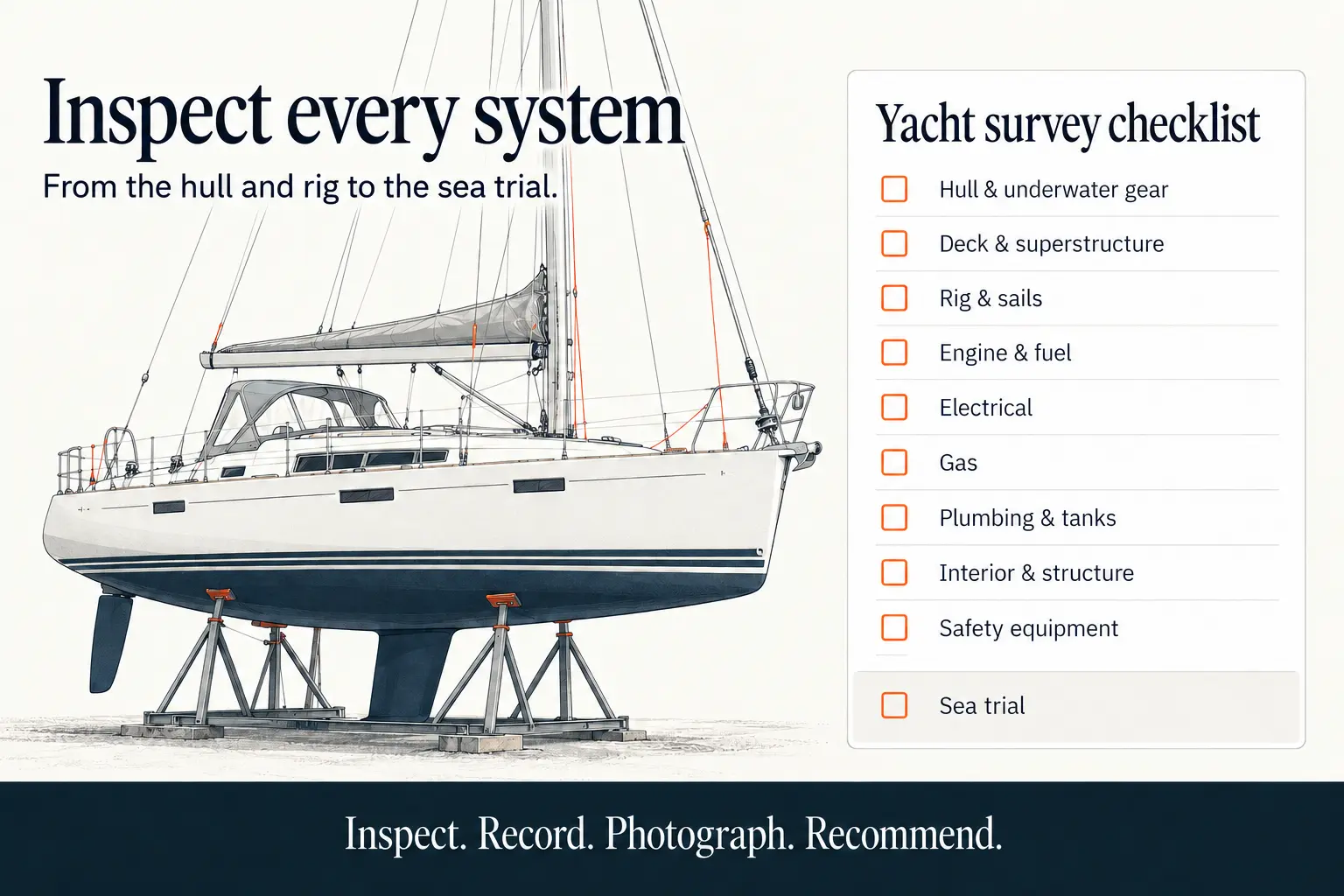
A yacht survey follows the boat from the outside in: hull and underwater gear first, then deck and rig, then everything behind the bulkheads, and finally a sea trial to see how it all behaves under load. The checklist below is the one most surveyors work through, whatever the report template looks like at the end.
If you are buying, use it to know what to ask about. If you are a surveyor, use it as a cross-check for your own list. If you run a charter fleet, most of it applies to your end-of-season inspections too.
Which survey are you getting?
The checklist barely changes between survey types. What changes is how deep the surveyor goes in each area and what the report is for.
| Survey | Who asks for it | Depth | What the report is used for |
|---|---|---|---|
| Pre-purchase | The buyer | Every system, out of the water, usually with a sea trial | Deciding whether to buy and at what price |
| Insurance (condition and valuation) | The insurer, through the owner | Structure, safety and the main risks, plus a valuation | Setting cover and conditions |
| Damage | Insurer or owner after an incident | The damaged area and anything it affected | The claim and the repair specification |
| Charter check-in and check-out | The charter operator | Visible condition and equipment, quickly and the same way every time | Deposits and the maintenance list |
A pre-purchase survey is the one people mean when they search for a boat survey checklist, so that is the one laid out below.
Before anyone arrives
A good survey starts with the paperwork. Ask the seller or broker for these before the day:
- Registration and ownership: registration documents, bill of sale history and anything showing who can legally sell the boat.
- Builder's documents: the builder's plate, hull identification number and CE or RCD paperwork for boats built for the European market.
- VAT status if the boat is kept in EU waters.
- Service history: engine hours and invoices, rigging replacement dates, liferaft and gas servicing records.
- Previous surveys, especially the last insurance survey and anything the insurer asked to be fixed.
The surveyor also needs the boat lifted or ready to be lifted, the batteries charged, the gas and water connected, and the lockers emptied. Arriving to find the cockpit lockers full of fenders costs an hour.
Hull and underwater
This is why the boat comes out of the water. On a GRP hull the surveyor will:
- Look along the topsides and bottom for distortion, repairs, impact marks and gelcoat cracking around stress points.
- Sound the hull with a light hammer, listening for dull areas that suggest delamination or voids.
- Take moisture readings across the underwater hull and compare them with readings above the waterline. Damp has several possible causes, so high readings are a prompt to investigate further.
- Check for osmotic blistering and note whether the boat has had previous osmosis treatment.
- Inspect the anodes: how much is left, whether they are fitted to everything they should protect, and whether they are wasting unusually fast.
Keel and keel-to-hull joint
Grounding damage often shows up here first. The surveyor checks the joint between keel and hull for cracking at the leading and trailing edges, sometimes called a keel smile, then goes inside to look at the keel bolts, nuts and backing plates for corrosion or weeping. On boats with a grounding history they will also look at the floors and the internal structure around the keel.
Rudder and steering
- Play in the rudder bearings, checked by rocking the blade fore and aft and side to side.
- Water weeping from the rudder blade, which suggests water in the core.
- Condition of the rudder stock and the hull around the rudder tube.
- Emergency tiller: present, fits and actually works.
Stern gear
- Propeller for damage, corrosion and the right fit on the shaft.
- Shaft for wear and straightness, and the cutless bearing for play.
- P-bracket mounting, or the sail drive leg and its seal on boats that have one.
- Shaft seal or stern gland type, condition and the date it was last serviced.
Through-hulls and seacocks
Every fitting below the waterline gets checked. The surveyor operates each seacock, looks at the material (ordinary brass, which dezincifies in seawater, is a common finding), checks that hoses below the waterline are in good condition and double clipped, and looks for softwood bungs stowed near each one.
Deck and superstructure
- Moisture and soundness in cored decks, especially around fittings, stanchion bases and the mast step.
- Bedding of deck hardware: cleats, winches, tracks, hatches and windows. Leaks here end up as wet core.
- Stanchions, pulpits and guardwires: secure, straight and the right height.
- Hatches and portlights: crazing, seals and whether they close properly.
- Cockpit drains: clear and big enough.
- Anchor, chain, windlass and the anchor locker.
Rig and sails
Most surveyors check the rig from deck level and recommend a rigger for anything aloft. From the deck they look at:
- Standing rigging age. Many insurers ask for a rigging inspection or replacement once the wire is more than ten to fifteen years old.
- Swage terminals for hairline cracks and rust staining.
- Chainplates and their attachment to the hull, often the most important item in the whole rig check.
- Mast step, partners and any signs of the deck or the step compressing.
- Spreaders, boom, gooseneck and kicker.
- Running rigging, winches and clutches.
- Sails: hoisted during the sea trial if possible, and checked for UV damage, stitching and the overall shape.
Engine and fuel
The surveyor will run the engine from cold, which says more than starting one already warm. On the checklist:
- Oil level and condition, coolant, belts, hoses and visible leaks.
- Engine mounts for sagging and cracks.
- Exhaust system, including the water injection elbow, which corrodes from the inside.
- Raw water strainer and impeller service history.
- Fuel tanks, lines, filters and the shut-off valve.
- Gearbox operation and the engine controls.
- Engine hours against the service record.
An oil sample sent to a lab is an extra worth paying for on an expensive engine. Ask the surveyor whether they can arrange it.
Electrical
- Batteries: age, secure mounting, ventilation and isolation switches.
- Wiring: chafe, crimp quality, fusing and amateur additions.
- Charging: alternator, charger and any solar or wind charging.
- Shore power: inlet, cabling, a residual current device and ideally a galvanic isolator.
- Navigation lights and instruments: working and correct for the boat's size.
Gas
Gas is one of the areas where surveyors are least forgiving, because the consequences are worst. Expect them to check:
- A gas locker that drains overboard and holds only the cylinders and regulator.
- The date printed on the flexible hose and the condition of the regulator.
- A bubble tester or similar leak test, and a gas alarm.
- Flame failure devices on the cooker.
- Whether the installation has been checked by a qualified engineer and when.
Plumbing and tanks
- Fresh water tanks, pumps and pipework.
- Heads, holding tanks and seacocks, including the anti-siphon loops.
- Bilge pumps, manual and electric: working, with the float switch tested.
- Hot water system.
Interior and structure
- Bulkheads and their tabbing to the hull, checked for cracks or separation.
- Signs of water ingress: staining, swollen joinery and mould behind linings.
- The hull-to-deck joint where it is visible from inside.
- Ventilation and the general state of the joinery.
Safety equipment
- Liferaft: capacity, service date and the manufacturer's service interval.
- Lifejackets: count, condition and whether they have been serviced.
- Fire extinguishers and a fire blanket, in date and within reach.
- Flares, if carried: expiry dates.
- EPIRB or PLB registration and battery date.
- Man overboard equipment and jackstays.
The sea trial
The sea trial ties the checklist together. With the boat back in the water, the surveyor looks for anything that only shows up under load:
- Engine temperature, oil pressure and exhaust while running at cruising and full revs.
- Vibration that suggests shaft misalignment or a damaged propeller.
- Steering response and any play.
- Leaks at the stern gland, through-hulls and around the keel while the boat works.
- Sails, winches and reefing under real load.
What ends up in the report
Every item above becomes either a note or a finding. A finding records what was found, where it is and what the surveyor recommends, and most surveyors sort the recommendations by priority. The usual split is something like: fix before the boat goes to sea, fix soon, and routine maintenance.
The quality of that list depends on how the surveyor captured it. A finding written on board, with the location and the measurement while the surveyor is still looking at it, is precise. The same finding reconstructed from photos and notes at the desk two days later is where readings get lost and locations turn vague.
That gap is what we built Axsail to close. Surveyors dictate as they work through the checklist above, and the findings are built with the system, location, measurement and a suggested priority while they are still on board. If something is missing, such as a reading, Axsail asks before they move on. The surveyor reviews every finding and signs the report. If you survey yachts and want to try it on your own boats, start a pilot.