
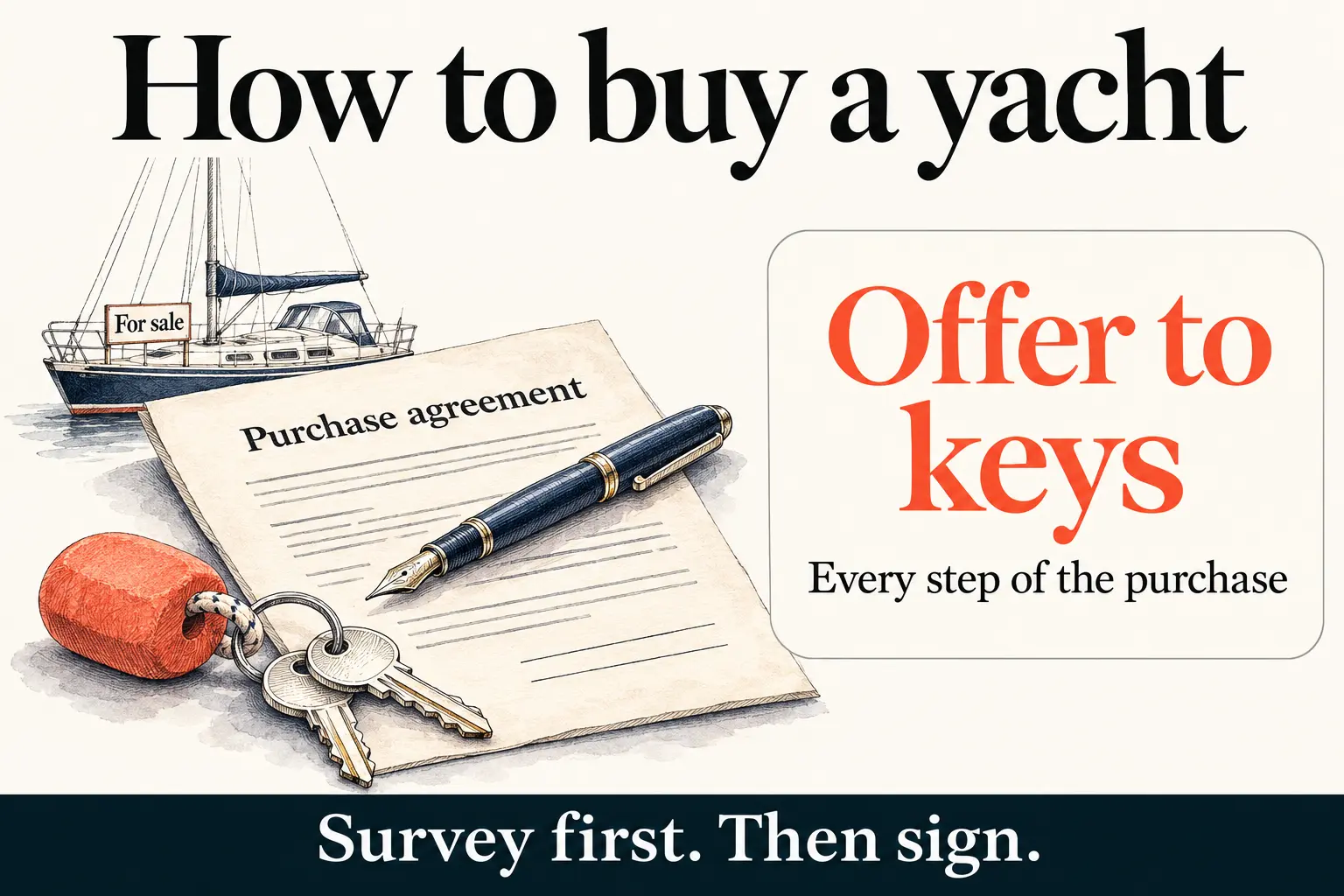
To buy a yacht, you set a budget that includes the running costs, find the boat with a broker or from a private seller, and make a written offer that's subject to survey and sea trial. You pay a deposit of about 10 percent into escrow, have the boat inspected by an independent marine surveyor, accept, renegotiate or walk away in writing, and then close: final payment, bill of sale, registration and insurance in your name.
That's the short version. This guide goes through each step of the yacht buying process for a used yacht, notes where a new build is different, and ends with the Amadea, a 106-metre Lürssen sold by the US government in 2025, where the buyer had no warranty at all and the survey was the only protection left.
The yacht buying process at a glance
| Step | What happens | Typical time |
|---|---|---|
| 1. Budget | Price, purchase costs and the yearly cost of owning | Before you look |
| 2. Choose the boat | New or used, sail or motor, model shortlist | Weeks to months |
| 3. Broker or private seller | Who finds the boat and runs the deal | Before viewings |
| 4. Viewing | First look, history and paperwork | A day per boat |
| 5. Offer | Purchase and sale agreement, subject to survey | 1 to 3 days to agree |
| 6. Deposit | Usually 10 percent, held in escrow | On signing |
| 7. Survey and sea trial | Hull, systems, engine, haul-out, sea trial | 14 to 30 day window |
| 8. Decide in writing | Accept, renegotiate or reject | Before the deadline |
| 9. Closing | Balance paid, title transferred, liens cleared | 1 to 2 weeks |
| 10. After closing | Registration, insurance, berth | Same week |
1. Set a budget that includes owning it
The asking price is the start. On top of the purchase, budget for:
- Purchase costs: the survey, haul-out and sea trial, an engine survey, a closing agent or lawyer, registration, and sales tax or VAT where it's due.
- Yearly costs: berth, insurance, servicing, antifouling, sails or canvas, and crew on larger boats. A rule of thumb often quoted is 10 percent of the boat's value a year.
- The first-year list: almost every used boat comes with one. The survey will tell you how long it is.
If you search "is buying a yacht worth it", the honest answer depends on how many weeks a year you'll use it. Price a week's charter of a similar boat and compare it with your yearly running cost.
Financing works much like a mortgage. Marine lenders lend against the surveyor's valuation, which is one more reason the survey matters: a valuation below the agreed price means a smaller loan.
2. New or used, sail or motor
A new yacht is bought from a builder or dealer. You sign a build contract with stage payments, choose the layout and options, and wait. When tennis player Carlos Alcaraz ordered a Sunreef Ultima 88, a 26.8-metre catamaran, it was announced at the Palm Beach International Boat Show in March 2026, with delivery to come. On a semi-custom or custom build, buyers usually hire a build surveyor to inspect the work at each stage, and the contract sets out sea trials and a warranty period.
A used yacht is cheaper, available now and has already lost most of its depreciation. It also has a history you need to uncover. This guide focuses on the used route, which is how most yachts change hands.
Popular used models give you plenty to compare, with known weak points that owners' forums and surveyors talk about:
- Sailing yachts: Beneteau Oceanis, Jeanneau Sun Odyssey, Bavaria Cruiser, Hallberg-Rassy, Amel.
- Catamarans: Lagoon, Fountaine Pajot, Leopard.
- Motor yachts: Princess, Sunseeker, Azimut, Fairline.
If you're buying a sailboat with no experience, start with a popular production model in your cruising area. They're easier to sell, parts are easy to find, and local surveyors know them well.
3. Buy through a broker or from a private seller
A buyer's broker finds boats that match your brief, checks listings and history, writes the offer, recommends surveyors and yards, and runs the closing. The seller usually pays the commission, shared between the listing broker and yours.
Buying a used boat from a private seller saves nothing on commission for you, since the seller would pay it anyway, but it can mean a lower asking price. You take on the broker's work: the contract, the escrow, and checking that the seller actually owns the boat and that no loan is secured on it.
Whoever you buy through, choose your own surveyor. The surveyor works for you alone.
4. Viewing: what to look for when buying a used boat
A viewing weeds out the wrong boats before you pay for surveys on them. Look at:
- Paperwork: registration or title, the builder's plate and HIN, service records, engine hours, receipts for big jobs.
- The hull and deck: stress cracks, soft spots underfoot, rust stains around fittings, repairs.
- Below: water marks on the joinery, a damp smell, a wet bilge, corroded wiring.
- The engine: a cold start with the owner present, smoke, oil in the bilge, the date of the last service.
Our yacht survey checklist goes through every system a surveyor inspects, and works as a buying a used boat checklist for your own viewings.
5. Make the offer: the purchase and sale agreement
Your offer is a written yacht purchase and sale agreement. Brokers use a standard form: the YBAA agreement in the US, the MYBA memorandum of agreement for larger yachts in Europe, or the broker's own. It sets out:
- the boat, its equipment and what's excluded;
- the price and the deposit;
- "subject to survey and sea trial", with a deadline for each;
- how you accept or reject the boat, and that it must be in writing;
- the closing date, place and who pays which costs;
- whether tax, such as EU VAT, has been paid on the boat.
The survey contingency is the clause that protects you. If the survey turns up problems, it lets you renegotiate or walk away with your deposit.
6. Pay the deposit
The usual deposit is 10 percent of the price, held in the broker's client account or by an escrow agent. It's refundable if you reject the boat under the contract, before the deadline. Once you accept, it usually isn't.
7. Survey and sea trial: the step that sets the price
The pre-purchase survey is the most important step in buying a yacht. An independent marine surveyor inspects the boat afloat and ashore, has it hauled out to check the hull below the waterline, runs it on a sea trial and writes a report that grades each finding by urgency. On motor yachts, add a separate engine survey and oil analysis. On sailing yachts, consider a rig survey.
You pay for the survey and the haul-out whether you buy or not. In the US it's about $25 to $35 per foot, so $1,000 to $1,400 on a 40-foot boat, or €17 to €29 per foot in Europe; our guide to boat survey cost has the rates per foot. For what happens on the day, how to choose a SAMS, NAMS, IIMS or YDSA surveyor and how to read the report, see pre-purchase yacht survey.
Go on the survey day. Being there for the haul-out, the sea trial and the debrief teaches you more about the boat than months of owning it.
8. Accept, renegotiate or walk away, in writing
With the report in hand, you have three options:
- Accept the boat as it is.
- Renegotiate: ask for a lower price, repairs before closing, or money held back in escrow until the work is done. Attach the report pages and written yard quotes.
- Reject the boat and get your deposit back.
Send it in writing before the deadline. Many agreements treat silence as acceptance.
9. Closing the yacht purchase
Closing is when the money and the ownership change hands. On a brokered sale a closing agent or the broker handles it; on a large yacht, lawyers on both sides. Before you pay the balance, make sure you have:
- a title and lien search showing the seller owns the boat and any mortgage will be paid off at closing;
- the bill of sale, signed by the registered owner;
- a deletion certificate from the old registry, if the boat changes flag;
- proof of tax status, such as VAT-paid evidence for a boat kept in the EU;
- a signed protocol of delivery and acceptance recording the date and place of handover.
10. After closing: registration, insurance and a berth
Register the boat in your name, with US Coast Guard documentation or state titling in the US, or with your chosen flag. Insurance usually needs to be in place from the moment of handover, and the insurer will ask for the survey report. If the insurer wants a separate survey, our guide to the boat insurance survey explains what they look for.
When the survey is all you have: the Amadea
Most used yachts are sold with a survey contingency. Sometimes the buyer gets no contingency and no warranty, and the survey becomes the whole basis of the price.
The yacht. Amadea is a 106-metre motor yacht built by Lürssen, with exterior design by Espen Øino, delivered in 2017. Fijian authorities detained her in May 2022 at the request of the US Department of Justice, which said she was beneficially owned by the sanctioned Russian billionaire Suleiman Kerimov. She was registered to Eduard Khudainatov, the former head of Rosneft, whom prosecutors called a front for Kerimov. The yacht was taken to San Diego.
The cost of keeping her. In 2024 the US Marshals Service put the monthly bill at $165,000 for maintenance, $75,000 for fuel and $360,000 for crew wages, plus insurance and a dry-docking estimated at around $5 million. A yacht that size can't simply be locked up: systems have to run, and the hull has to be looked after.
The sale. In March 2025, Judge Dale Ho of the US District Court for the Southern District of New York ordered the yacht forfeited. She was sold by sealed bid closing on 10 September 2025, run by National Maritime Services with Fraser as promotional agent. The terms were blunt:
- sold "as is, where is" from her San Diego berth, with no warranty as to condition;
- bidders had to rely entirely on their own inspections and due diligence;
- a minimum net worth of $500 million and KYC checks to register;
- a $10 million deposit in escrow before bids closed.
The sale documents for registered bidders listed a hull survey report, a hull deficiency report, engine and generator diagnostics, an underwater video of the bottom and class records. Every serious bidder still sent their own team. Three years with a government crew is a gap no buyer would price on someone else's word.
The result. The price wasn't disclosed. YachtBuyer put her value at about $230 million. Khudainatov appealed the forfeiture and his lawyer called the sale premature, so title risk sat on top of condition risk.
Axioma: 63 bids after inspections in Gibraltar
Three years earlier, the 72.5-metre Axioma, linked to Russian steel magnate Dmitry Pumpyansky, was arrested in Gibraltar in March 2022 over a loan dispute with JPMorgan. Representatives of prospective buyers inspected her at her berth, the Admiralty Marshal received 63 sealed bids, and she sold in August 2022 for $37.5 million, well below the values reported for her before the arrest.
At a court sale, no seller answers for defects afterwards, so bidders discount for every unknown. The bidder whose surveyor learned the most in the time allowed could afford to bid closer to her real worth.
What a buyer can take from both sales
- The survey sets the price. On an ordinary brokered sale the contingency lets you renegotiate afterwards. On an as-is sale the negotiation happens before you bid, and the survey is all of it.
- Someone else's report is a starting point. A survey commissioned by the seller, a lender or a government answers their questions. Your surveyor answers yours.
- Time laid up matters. Months without use, a reduced crew or a skipped service show up in machinery, seals and the hull. Ask how the boat has been kept, and have the surveyor check the answer.
- Title is part of due diligence. Amadea's buyer bid with an appeal over ownership still open. On any purchase, the lien and title search is as important as the haul-out.
For surveyors: every buyer above needs a report
The process above has one step where a professional has to put their name to what they found. Behind every survey is a day on board and then another day or two writing it up.
Axsail writes that report as you go. You talk through the boat and take photos, and each observation becomes a finding with its system, location, reading, recommendation and grade, with the photos placed on it. Missing readings are asked for while you're still on board. The draft, with particulars, sea trial tables and a valuation section, is ready minutes after the walk-round. Start free on your next pre-purchase survey.