
Axsail
GUIDE · BOAT MAINTENANCE AND COSTS

Bottom paint for boats: ablative or hard, aluminium hulls, how much and what it costs

UPDATED 12 NOVEMBER 2026 · 3 MIN READ

Choosing antifouling bottom paint: ablative or hard, copper-free paint for aluminium, changing paint types, how much you need and what yards charge per foot.

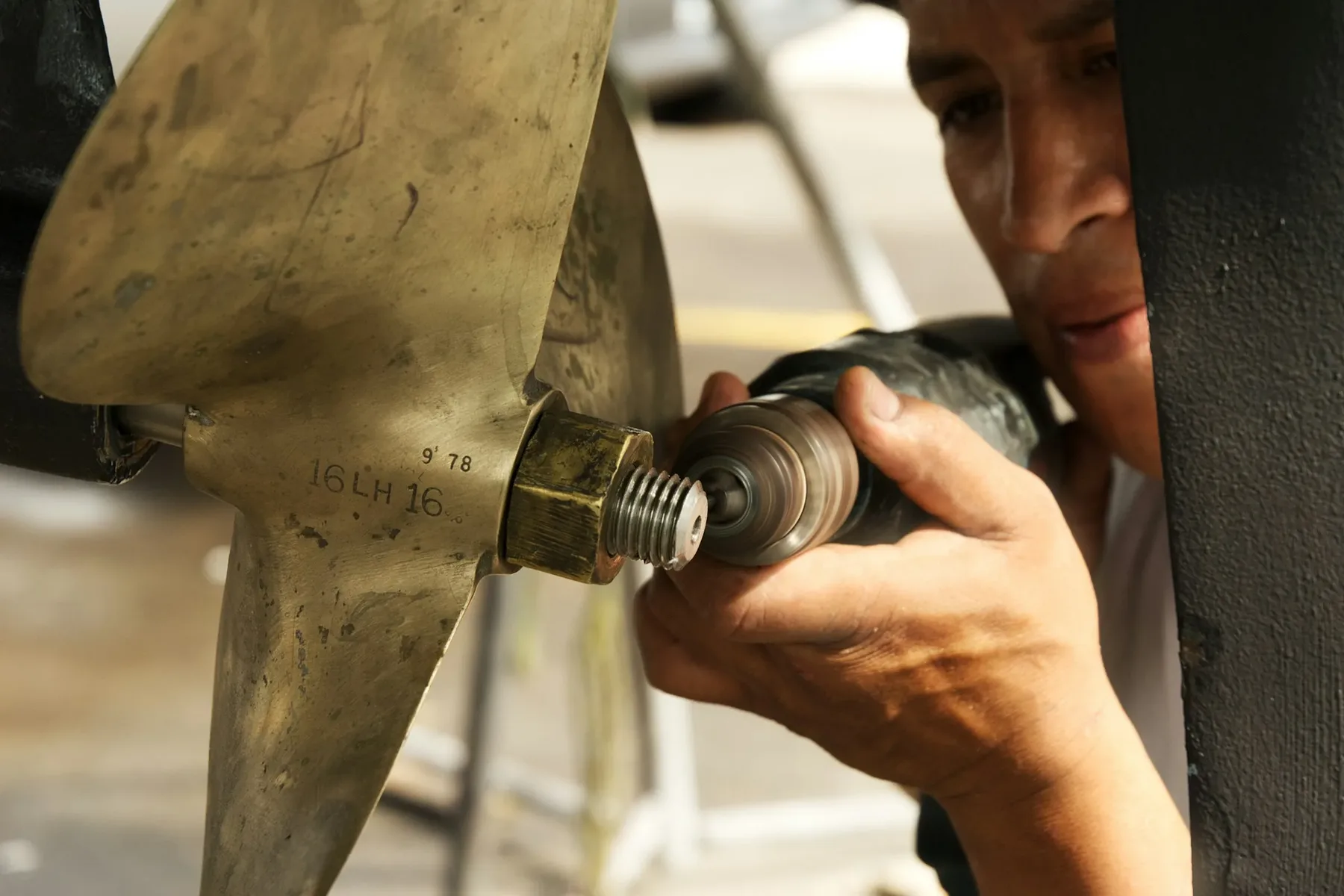
A technician working on a yacht propeller

Bottom paint keeps weed and barnacles off the hull by releasing a biocide, often copper, into the water. The choice comes down to how the boat is used, what the hull is made of, and what's already on it.

Ablative or hard

Ablative Hard
How it works Wears away gradually, releasing more biocide as the boat moves Stays in place as a film
Over the years Wears thin, so you add more Builds up in layers that eventually need blasting off
Suits Boats used often; self-polishing types for boats that sit Racers and fast boats scrubbed often
Recoating Only when it wears thin Single-season paints every season

That's Soundings' summary. Practical Sailor puts the long-term difference in a line: ablatives wear away, hard paints "form thick layer cakes". It also warns that some paints, typically hard ones, lose their effect if the boat is hauled and relaunched without repainting, and need a light sanding to reactivate.

Some products sit between the two. Soundings describes Interlux Bottomkote NT as combining hard and ablative properties, and Trilux 33 as a slow-polishing multi-season ablative that holds up on fast powerboats.

Aluminium and steel hulls

Copper and aluminium don't mix. Interlux says copper oxide antifouling can go on a hull of any material except aluminium, and Soundings explains why: the copper reacts galvanically with the aluminium, and the aluminium loses. Aluminium owners usually choose a metal-free biocide such as tralopyril, sold as Econea, which Soundings says works on any hull and on underwater metal. Practical Sailor adds that aluminium saildrives need copper-free paint too.

Steel hulls can take copper oxide paint over the right primer. Practical Sailor notes that bare fibreglass or metal needs a primer.

Changing paint type

Practical Sailor's first rule is to choose a paint compatible with what's already on the hull, unless you're ready for more than a light sanding. A hard paint can usually be covered with either type. An ablative needs more sanding or a tie-coat before a hard paint goes over it. The makers publish compatibility guidance.

How much paint

Interlux gives a rough estimate of the underwater area: length overall × beam × 0.85. Divide by the coverage of the paint you've chosen, and multiply by the number of coats; Interlux's quick chart assumes two. Our antifouling paint calculator does it in feet or metres.

What a yard charges

Yard Bottom paint labour Included
Huckins Yacht, Jacksonville $26 per foot up to 39 ft, $28 up to 49 ft, plus material Six hours of sanding; haul, block and launch charged separately
Liberty Landing Marina $20 per foot plus paint and materials $21.50 per foot with your own paint

Add the haul-out: see boat haul-out cost for yard prices per foot in the US and France.

What the surveyor looks at

Out of the water, the surveyor sees the bottom before it's painted: blisters, cracks, the condition of the old coating and the metal fittings under it. See osmotic blistering and the out-of-water survey. With Axsail the surveyor dictates each finding under the hull, with its photo, while the boat is in the slings.

Frequently asked

Is ablative or hard bottom paint better?

It depends on the boat. Soundings says ablatives suit boats used often and self-polishing ablatives suit boats that don't move much, while racers and fast powerboats often pick a hard paint that stands up to scrubbing. Ablatives wear away; hard paints build up in layers that eventually have to come off.

Can I use copper bottom paint on an aluminium boat?

No. Interlux says copper oxide antifouling can go on hulls of any material except aluminium, and Soundings explains the copper reacts galvanically with the aluminium. Aluminium boats usually get a metal-free biocide paint.

How much bottom paint do I need?

Interlux's rough estimate of the underwater area is length overall × beam × 0.85. Divide that by the coverage on the can, and multiply by the number of coats. Our antifouling paint calculator does the sum.

How much does it cost to have a boat's bottom painted?

Rate sheets we've read range from $20 per foot plus paint at Liberty Landing Marina to $26 to $28 per foot plus material at Huckins Yacht, which includes six hours of sanding. The haul-out is charged on top.

Your full survey report, minutes after the walk-round

Dictate as you inspect. Axsail builds the findings and the report for your signature

Start free

More guides

All guides
BOAT MAINTENANCE AND COSTS · 3 MIN

Boat haul-out cost: what yards charge per foot to lift, wash, block and launch

What a boat haul-out costs, from yard rate sheets in the US and France: a short haul for a survey, haul, wash, block and launch per foot, and storage.

BOAT MAINTENANCE AND COSTS · 2 MIN

Winterizing a boat: engine, fuel tank, water systems and batteries

How to winterize a boat: stabilized fuel and how full to leave the tank, antifreeze through the engine, outboards, water systems and batteries, with a checklist.

BUYING A BOAT IN THE US · 2 MIN

Boat bill of sale in Alabama: notarized signature, 15-day transfer and registration

Buying a used boat in Alabama: what the bill of sale must show, the notarized seller signature, the 15-day transfer, titles and where sales tax is paid.

BUYING A BOAT IN THE US · 2 MIN

Boat bill of sale in Florida: title transfer, form 82040 and sales tax

Buying a used boat in Florida: which boats need a title, the title's transfer section, form 82040, when a bill of sale is needed, 6% sales tax and the 30-day notice.

BUYING A BOAT IN THE US · 2 MIN

Boat bill of sale in South Carolina: SCDNR titles for boats and outboards

Buying a used boat in South Carolina: separate titles for boats and outboards, when SCDNR wants a notarized bill of sale, the 5% tax capped at $500 and fees.

BUYING A BOAT IN THE US · 2 MIN

Boat bill of sale in Tennessee: no title, so the bill of sale is the proof

Tennessee doesn't title boats, so the bill of sale proves the purchase. What TWRA asks it to show, the county clerk's tax certification and registering a used boat.